

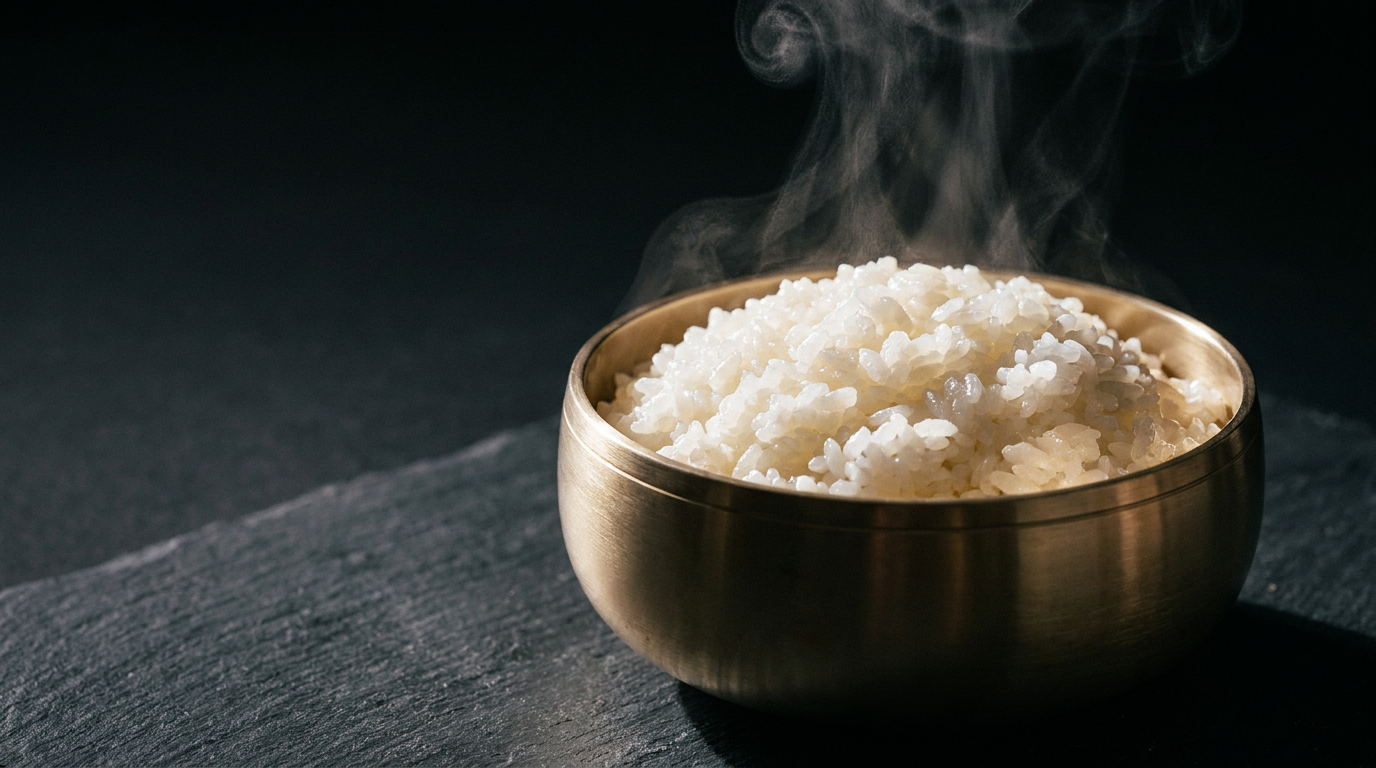
South Koreans no longer eat as much white rice as they once did. Per capita consumption has fallen to less than half its peak. And yet—rice prices are at an all-time high, convenience store onigiri are flying off the shelves, and brand-name rice, craft makgeolli, and rice-flour delicacies are driving a new food scene. We explore the current state of South Korea, where "moving away from rice" and a "rice boom" are happening simultaneously, viewed through the lens of a food enthusiast and compared with its neighbor Japan, which is traveling down the same path (the "Reiwa Rice Riots" of 2024–2025).
01 / DATA"Moving away from rice" by the numbers: Both Japan and Korea at less than half their peak
Let’s start with the facts. South Korea’s annual per capita rice consumption peaked at 128.1kg in 1985 and has been falling ever since, dropping to 56.4kg in 2023. That is less than half in about 40 years. It first dipped below 60kg per person in 2019 (59.2kg), and has continued to set new lows almost every year since, with 57.7kg in 2020 and 56.9kg in 2021. With options like ramen, bread, and multi-grain rice expanding at the dinner table, the era of "just give me a big bowl of white rice" is quietly coming to an end.
Annual consumption at its peak
Per capita consumption
Decrease over approx. 40 years
This trend is identical to Japan’s. Japan’s per capita consumption peaked at 118.3kg in fiscal 1962 and has continued to decline, hitting a record low of 51.1kg in fiscal 2023 (rising slightly to 53.4kg in fiscal 2024 amid rice shortages). Because Korea’s peak was about 20 years later than Japan’s, it is currently tracing a downward curve that mirrors Japan’s own trajectory. From the "star" of the table to a "supporting role"—the status of rice has changed significantly in both countries.
02 / PARADOXConsumption is down, but prices are at their highest: The "Rice Paradox"
One might assume that as consumption drops, prices would fall—but the reality is the opposite. The 2025 farm-gate price for rice in Korea hit an all-time high. The average rice price during the harvest season reached approximately 239,140 won, and the government’s purchase price for stockpiled rice (per 40kg of unhusked rice) exceeded 80,000 won for the first time.
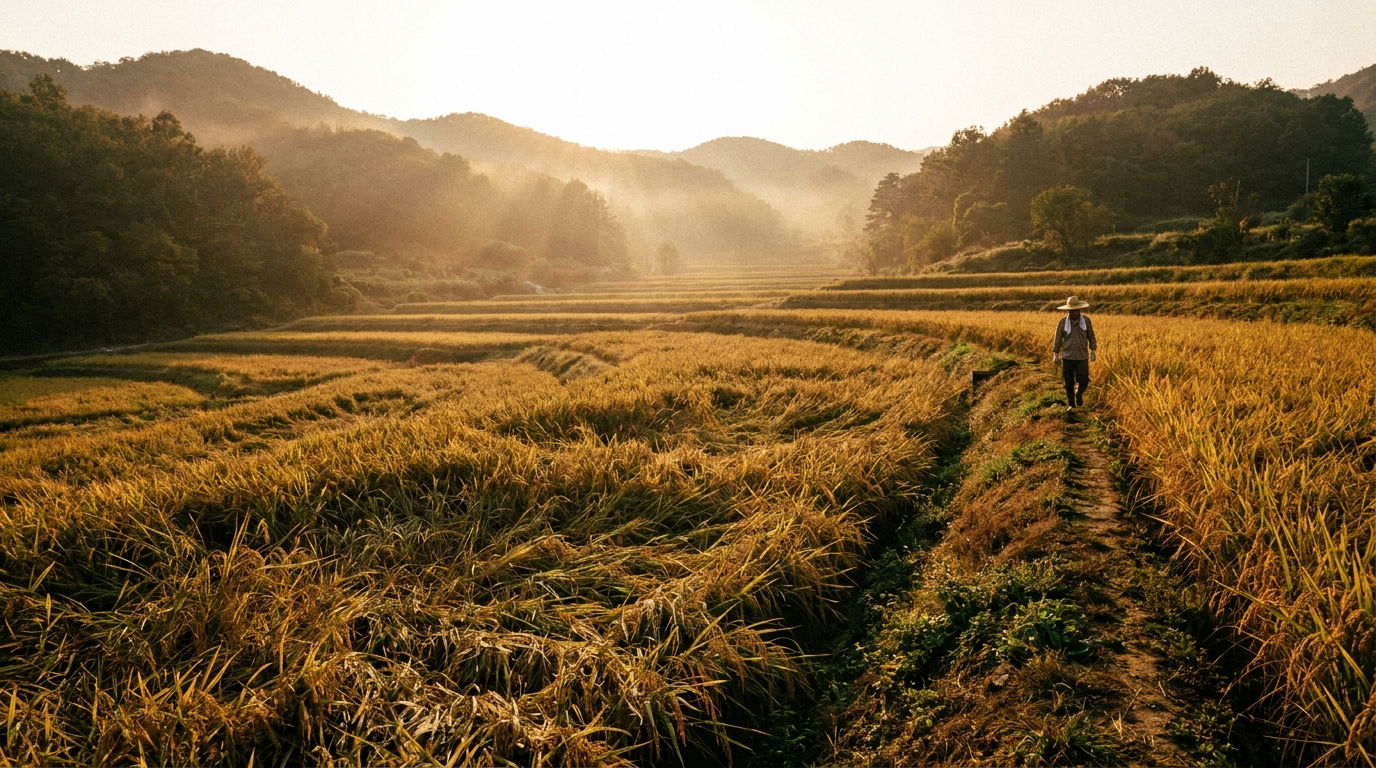
The mechanics behind this lie in supply, demand, and policy. Production for 2025 was 3.574 million tons, exceeding the estimated demand of 3.409 million tons by 165,000 tons—an overproduction. To stabilize prices, the government "market-isolated" (bought up) 100,000 tons, tightening the supply available to the market. In the previous year, they also isolated 266,000 tons, which was even higher than the surplus; this prevented price drops and instead sustained a trend of rising prices.
Even though we are eating less, production doesn't decrease proportionately, so the government buys the excess to support prices—in Korea, rice has become a crop whose price is determined not by the "market," but by "policy."
03 / JAPANThe same is happening across the sea: Japan’s "Reiwa Rice Riots"
"Consumption is down, yet prices are up"—this same paradox actually occurred in Japan, and in a more dramatic fashion. The surge in rice prices that hit Japan between 2024 and 2025 is known as the "Reiwa Rice Riots." The price of major brands like Koshihikari jumped nearly twofold, from about 2,561 yen for 5kg in June 2024 to about 5,072 yen in June 2025. Empty supermarket shelves and signs restricting purchases became a common sight.

The triggers were multifaceted. Record-breaking heat and low rainfall in 2023–2024 degraded rice quality, significantly reducing the amount of high-quality rice available for market. This was compounded by panic buying following Nankai Trough earthquake advisories, speculative purchasing at the wholesale level, and a shift in demand back from bread and noodles. Inventories dwindled, and even when new rice reached the market, prices did not fall.
Here, too, the government intervened. In January 2025, the Ministry of Agriculture, Forestry and Fisheries revised operational rules to allow the release of stockpiled rice even in years without a "major crop failure," adding "market stagnation" as a new criterion for release (with a mandatory buy-back clause to replenish the same amount within a year). Once the stockpiled rice hit the market in June 2025, retail prices finally began to stabilize. While Korea "buys up to tighten," Japan "releases to loosen"—the approaches are opposite, but the two countries are perfectly aligned in that government intervention is what ultimately decides the price.
04 / COMPAREComparing the "Rice Structure" of Japan and Korea: Acreage reduction and market isolation
One cannot fully understand the Korean rice situation by looking at Korea alone. Only when placed alongside Japan does it become clear: "This is a structure common to developed East Asian nations." In both countries, rice consumption halved alongside post-war Westernization, yet production did not decrease as rapidly as demand, leading to chronic oversupply. Consequently, both governments chose to support prices by intervening in production and distribution.

| South Korea | Japan | |
|---|---|---|
| Consumption Peak | 1985 / Approx. 128kg | Fiscal 1962 / Approx. 118kg |
| Recent Consumption | 2023 / 56.4kg | Fiscal 2023 / 51.1kg (Record low) |
| Means of Price Support | Market isolation (Buying up surplus rice) | Acreage reduction/subsidies & stockpiled rice release/buy-back |
| Recent Price Situation | 2025 crop at record high | Doubled during 2024–25 "Reiwa Rice Riots" |
The methods differ slightly in nuance. Japan "abolished" the acreage reduction policy (limiting planting area to curb production) in 2018, but the system of providing subsidies to convert from staple rice to other crops remains, effectively continuing supply and demand adjustments today. Korea’s market isolation is an adjustment at the "exit," where the government buys up surplus rice already produced to isolate it from the market. Japan suppresses at the "entrance," while Korea siphons off at the "exit"—the approaches are contrasting, but the goal is the same: to protect rice farmers and stabilize prices.
The shortcut to understanding Korean rice is to look back at Japan's. Consumption halved, overproduction, government intervention, and price spikes—two similar stories with the hands of the clock shifted by 20 years, both currently in motion.
The differences are also interesting. In Japan, single-brand labels like Koshihikari became established early on, whereas in Korea, the culture of "choosing by variety" has only matured over the last decade. Conversely, the speed at which convenience store onigiri and Home Meal Replacements (HMR) have spread, and the enthusiasm of the younger generation for traditional alcohol and rice-flour delicacies, makes the current Korean market feel even more vibrant. Within the same large flow of decline, both countries are showing us slightly different versions of the "reinvention of rice."
05 / CONVENIENCEThe "Onigiri Revolution" from convenience stores and the HMR boom
White rice cooked at home has decreased. Where did that rice go? One answer is convenience stores. Once upon a time in Korea, there was a deep-seated belief that "only people with no money eat cold rice," so convenience stores rarely stocked onigiri. That was overturned by business managers who refined the quality and pushed them to become flagship items, and today, Korea is a bona fide "onigiri superpower."
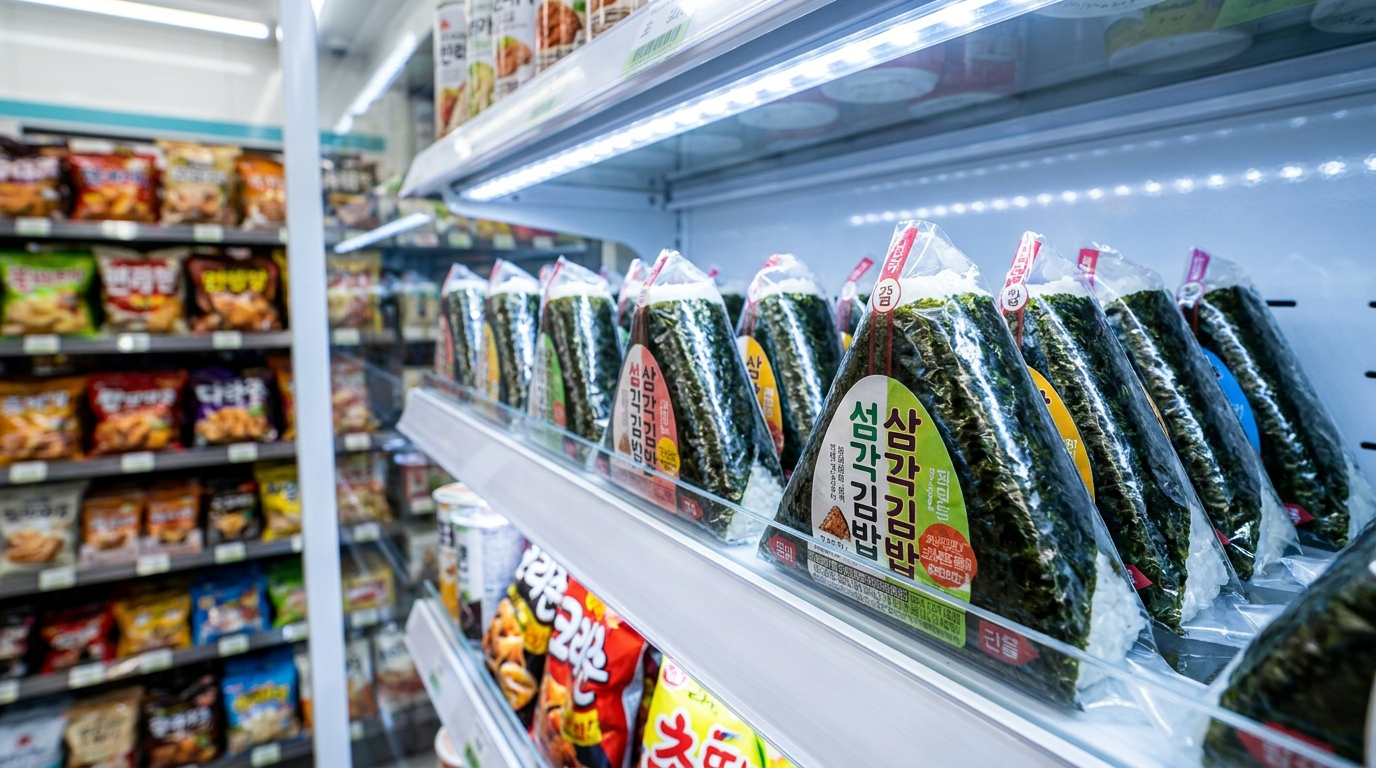
The numbers support the momentum. At the major convenience store chain CU, there was a year where sales for the entire HMR category grew 26.1% year-on-year, with onigiri alone seeing a 25.2% increase. This is backed by the increase in single-person households and the entrenchment of "hon-bap" (eating alone) culture. From the family rice cooker to the convenience store shelf and freezer—the scene of rice consumption itself is shifting. You could say that Korea is currently chasing and aggressively overtaking the model Japan pioneered with convenience store onigiri.
Foodie Note: Evaluating Triangular Gimbap
- The standard is tuna-mayo, but in recent years, "side dish-style" flavors like bulgogi, kimchi fried rice, and pollack roe have grown popular.
- The film opening method follows the same "①②③" style as Japanese triangular onigiri. The crispiness of the seaweed is everything.
- The "K-Food" related market has expanded about 1.5 times in roughly five years. Frozen rice and meal kits are also worth checking out.
06 / TERROIRThe era of brand-name rice: Choosing by variety and region
From quantity to quality. As consumption declines, eyes become more discerning regarding every bowl of rice. Like Japan's "Koshihikari," single-variety brand rice has begun to take root in Korea. From cafeteria staples to high-end varieties, the range of flavor profiles is surprisingly broad.
Major varieties to remember
- Shindongjin (신동진) / Produced in North Jeolla Province. The grains are about 1.3 times larger than other varieties, offering a firm, "chewy and plump" texture rather than soft and sticky. A staple found in cafeterias.
- Odae (오대) / Produced in Gangwon Province. A highly-regarded, delicious variety grown in a cool climate.
- Icheon Rice / The go-to name when talking about "regions with delicious rice" in Korea. Each grain is plump and elegant; it's considered "premium grade," often cited as comparable to Koshihikari.
Korean rice is Japonica, so it is often thought to be similar to Japanese rice, but the flavor profile changes significantly depending on the variety and polishing grade. Prices aren't necessarily cheap, so the smart approach for foodies is to "buy a small amount of a trusted brand and decide whether to repeat."
07 / REINVENTIONReinventing Rice ①: Craft & Premium Makgeolli
Rice is not just for "cooking." The most exciting "reinvention of rice" currently taking place is in the world of Korea's traditional alcohol, makgeolli. It once had a strong image as a "cheap, mass-produced drink for middle-aged people," but the landscape has changed completely in the last few years.
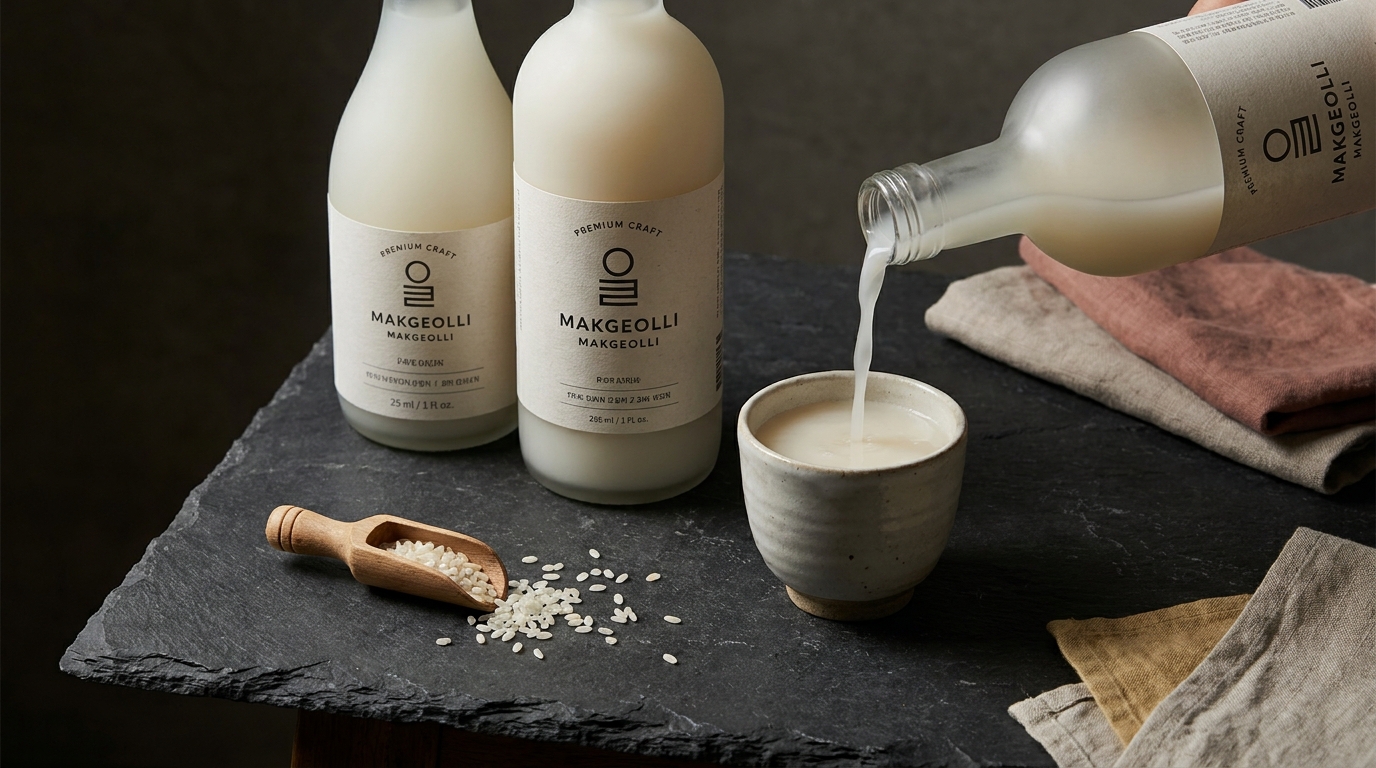
Breweries of various sizes across the country are releasing craft makgeolli that focuses on the fermentation process and high-quality raw rice. With the entry of young entrepreneurs, labels have become sophisticated, and their aesthetic has become "Instagrammable." It is no longer rare to find premium makgeolli that costs thousands of yen per bottle, and versions with over 10% alcohol content that offer rich, complex flavors are also appearing. Like wine, choosing by "region," "rice variety," and "brewery" is a way of drinking that is spreading among the younger generation. It’s fascinating to see them trace the path of local sake and craft trends, but with makgeolli instead of rice shochu.
08 / REINVENTIONReinventing Rice ②: Rice Flour Delicacies and Gluten-Free
The other star is rice flour (komeko). Rice flour has always been a material supporting traditional food, as the main ingredient in the cakes for Korea's national dish, tteokbokki (some formulations for rice cakes are 90% rice flour). Now, the global gluten-free trend has added momentum.
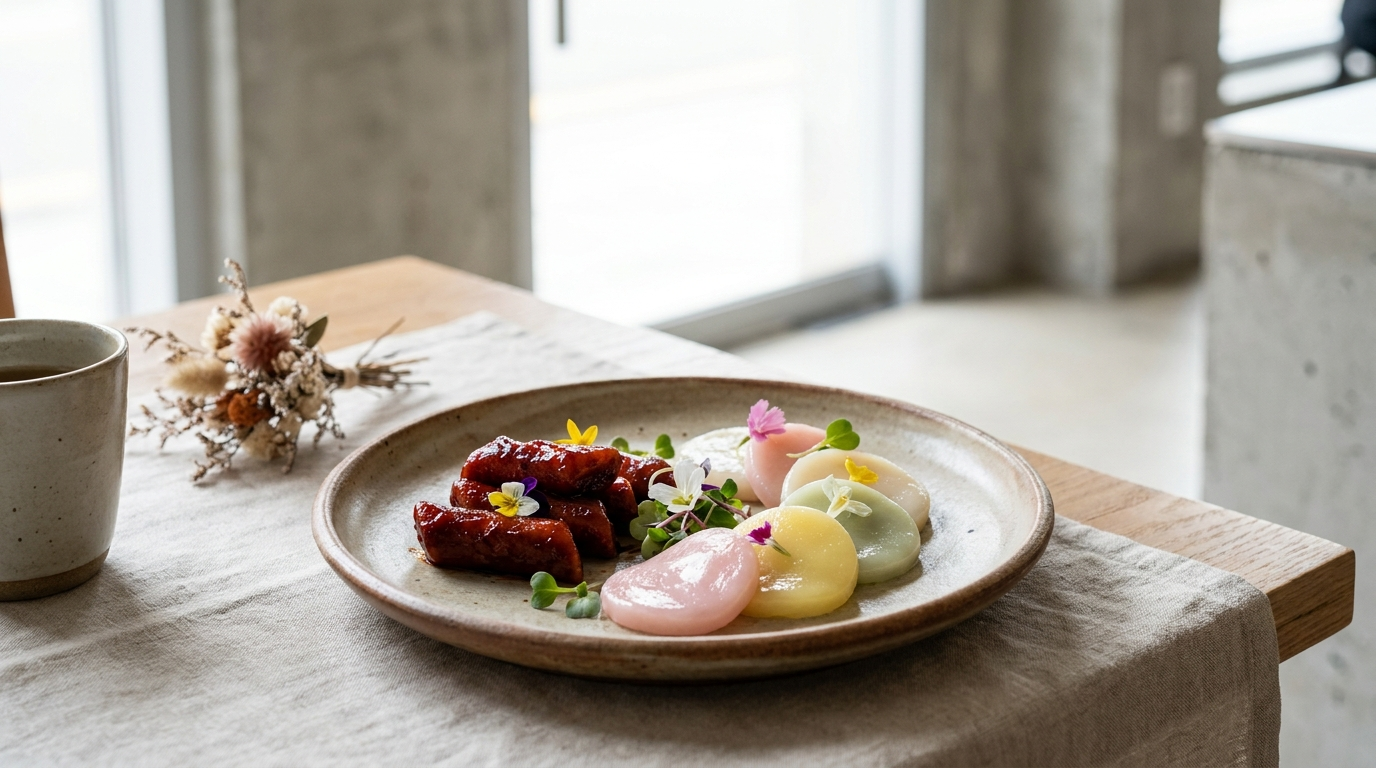
Noteworthy food trends include "flour alternatives" like rice flour bagels and rice flour churros. They are supported because they are lighter than wheat and have a unique, chewy texture. From traditional foods like tteokbokki to cafe sweets—rice flour is quietly increasing its presence as a "material connecting old and new" in the Korean food scene. In the sense of transforming surplus rice into valuable ingredients, this may also be a "private-sector version" of supply and demand adjustment.
09 / GUIDEHow to enjoy it locally for foodies
Korean "Rice" Experience Checklist
- Ask about the variety at restaurants / Specialized shops often use Shindongjin or specific regional rice. Clay pot rice (sot-bap) restaurants are often good bets.
- Check the grade display at supermarkets / Korean rice has grades. Check the region, variety, and polishing date for the best results.
- Try makgeolli by the brewery / Try local "raw (saeng) makgeolli" or craft labels one by one. Enjoy comparing them like you would wine.
- Eat "the now" at convenience stores / Triangular gimbap and frozen rice are fixed observation points packed with the reality of Korean dietary life.
- Compare with Japanese rice / Even as Japonica, the flavor, price, and selling methods are subtly different. Compare it with Koshihikari after returning home, and you can taste the "now" of both countries.
10 / SUMMARYConclusion: Not "moving away from rice," but "diversification of rice"
If one were to summarize the rice situation in Korea in a word, it is not "moving away from rice," but the "diversification of rice." While white rice cooked at home has certainly decreased, rice has changed its form into convenience store onigiri, brand-name rice bowls, glasses of makgeolli, and rice-flour bagels, effectively broadening the food scene. The rice situation in modern Korea cannot be measured by the single yardstick of consumption volume alone.
And the same story is underway in Japan, which walked the same path 20 years earlier. With Japan having experienced the "Reiwa Rice Riots" and Korea using market isolation to support prices, both countries are holding the same paradox of "less consumption yet higher prices" while protecting and reinventing rice in their own ways. Being able to compare two adjacent rice-eating cultures—for a foodie, there is no combination more worth "eating your way through."
Frequently Asked Questions (FAQ)
- How much has South Korea's per capita rice consumption dropped?
- It peaked at 128.1kg in 1985 and was 56.4kg in 2023. It has more than halved in about 40 years. It first dropped below 60kg in 2019.
- Which country eats more rice, Japan or Korea?
- They are now roughly equal. In 2023, Korea was at 56.4kg and Japan was at 51.1kg. Japan consumes slightly less, and its peak (1962, approx. 118kg) occurred about 20 years earlier than Korea's (1985, approx. 128kg).
- Why are rice prices rising when consumption is falling?
- Because production does not decrease faster than demand, leading to surpluses that governments intervene to adjust. Korea uses "market isolation" (buying up surplus rice), while Japan uses acreage reduction, conversion subsidies, and the release of stockpiled rice. The 2025 Korean crop is at a record high, and in Japan, the "Reiwa Rice Riots" of 2024–25 saw 5kg prices double.
- What are the "Reiwa Rice Riots"?
- A shortage and price surge in Japan from 2024 to 2025. Factors like quality degradation due to heat, panic buying, and a return in demand led to major brands jumping from about 2,561 yen to about 5,072 yen per 5kg. The government released stockpiled rice, and prices stabilized after June 2025.
- What are the famous brand-name rice varieties and regions in Korea?
- Shindongjin (신동진) and Odae (오대) are famous varieties, and Icheon rice is a well-known premium-grade region.
- What "rice" souvenirs should I buy when traveling to Korea?
- Sophisticated craft/premium makgeolli, rice-flour sweets, and small bags of premium rice are popular among foodies.
ClosingHow to face change, as seen from a single bowl of rice
The journey through Korean rice is, on paper, a story of "decline." But when looking closer, it isn't decline, but a continuous series of reinventions. From the family pot to the convenience store shelf, from white rice to a bowl of brand-name rice, and into glasses of makgeolli and rice-flour bagels, rice continues to keep its place at the center of people's lives while changing its form. Japan, having climbed this same slope 20 years earlier, is also currently re-measuring the distance between itself and rice following the "Reiwa Rice Riots."
To maintain value even when consumption decreases, one must not compete on quantity, but refine quality and polish how one chooses—this applies to more than just the dinner table. It feels as though this aligns quietly with the concepts of order, balance, and harmony that KEMA values in daily hair care. Not too much, not too little, finding the comfortable balance for oneself. I would be delighted if, the next time you enjoy a bowl of Korean rice, you remember that "joy of choosing."


